The CS degree you never got
A complete introduction to computer science for self-taught developers.
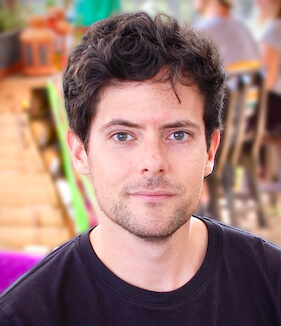
Written by Tom Johnson
Sound familiar?
- You can ship features, but you don’t know how far to trust what your AI assistant is telling you.
- You only find out about an important concept after an embarrassing code review or causing a production incident.
- You know you have gaps, but you don’t have time to read a dozen giant computer science textbooks.
The problem is that you don’t know what you don’t know.
This book fixes that. It gives you the fundamental building blocks you need to succeed.
I know the feeling. I once brought down a system during a busy sales period because I didn’t know what a file handle was. Turns out you can run out of them and crash the system!
I spent five years reading textbooks and watching lectures to fill my own knowledge gaps, then turned the useful parts into a practical map for working developers.
“Incredibly helpful for building the missing foundations behind highly abstracted systems.”
Kelven Opoku, backend engineer in Big Tech
Buy the ebook - $19.99- ✅ 28-day money-back guarantee
- ⭐ 4.6 stars on Amazon
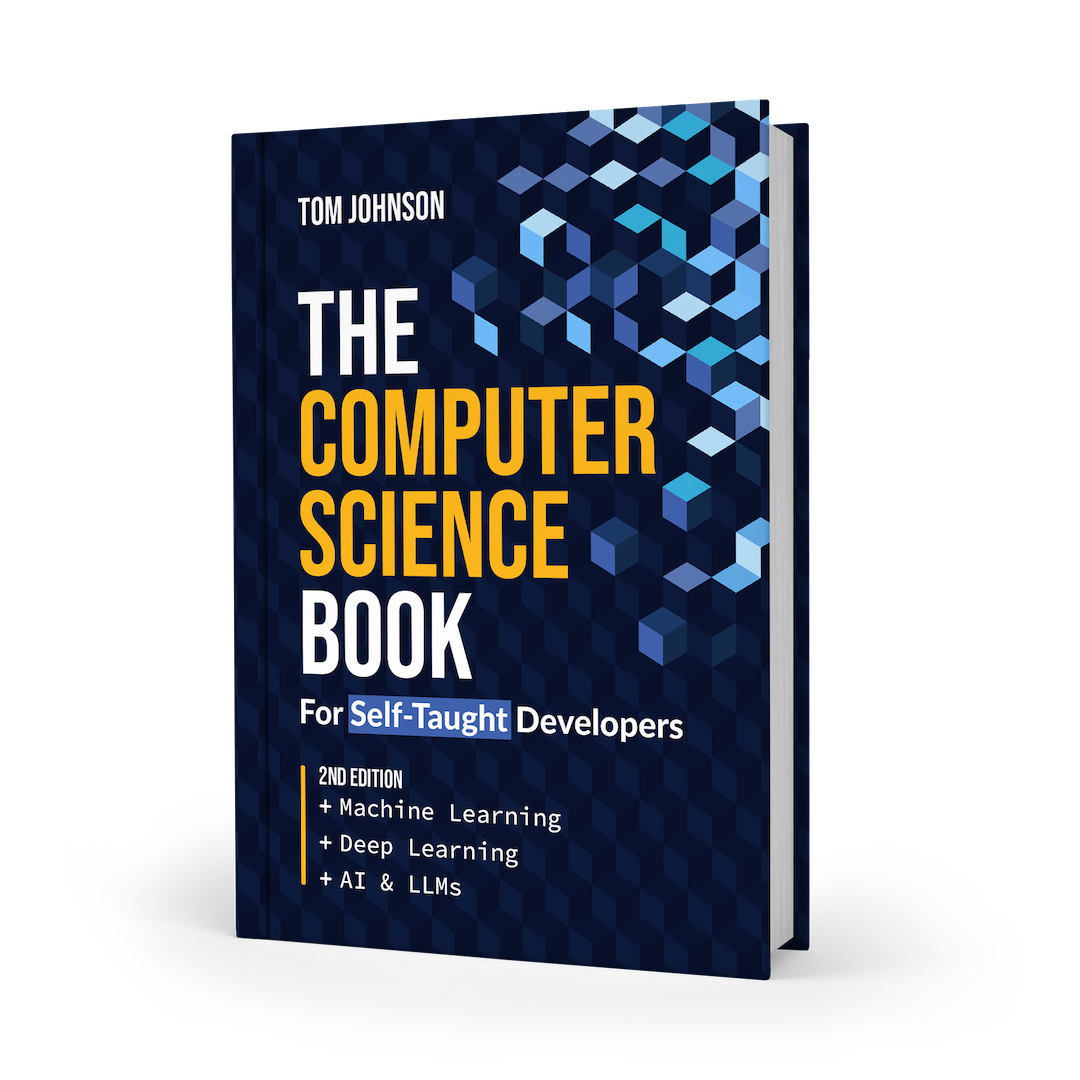
The Computer Science Book: For Self-Taught Developers
Learn the computer science fundamentals from logic gates to LLMs
The building blocks you need
The Computer Science Book is a guided, opinionated walk through the core areas of a computer science degree. It’s aimed at anyone who needs a practical understanding of computer science fundamentals.
This is not a thousand-page reference manual. It is a curated introduction to the parts of computer science that working developers actually need to know.
You’ll build intuition across thirteen chapters ranging from the logical foundations to the bleeding edge of AI research:
- Machine learning – the essential primer on the techniques of the AI revolution
- Deep learning – how neural networks function and how to use them well
- Large language models & AI – how LLMs and AI agents actually work
- Computer architecture – how your computer works from logic gates up
- Operating systems – processes, virtual memory and filesystems in depth
- Theory of computation – what computers can and can’t do
- Algorithms and data structures – how to reason about data and performance
- Networking – what actually happens between your browser and the server
- Concurrent programming – modern programming for maximum performance
- Distributed systems – resiliency and coherency at web scale
- Programming languages – how syntax and semantics determine paradigms
- Databases – how to store data securely and query efficiently
- Compilers – how your source code actually turns into a program
Each chapter builds up an intuitive understanding of the most important topics. You’ll map out the territory and understand how everything fits together.
When you want to go deeper, comprehensive Further Reading sections signpost more advanced topics and resources.
What readers say
Practical CS foundations for developers who want the map underneath modern software.
Incredibly helpful in rebuilding the missing foundations behind highly abstracted systems. The networking chapter immediately changed how I reason about requests, responses, and system boundaries.
An essential read for anyone who missed out on a CS education. Tom distils each topic beautifully, and the further reading is excellent.

Covers all the topics I lacked confidence in. I now have a solid base when I need to dive deeper. I really recommend this book.

One of the best CS books ever written. Most beginners need a good overview, and most books go in depth way too fast.
Your explainer for the age of AI
Three new chapters spanning the basics of machine learning to the cutting edge of AI. Existing chapters revised and expanded. Almost twice the content!
Machine Learning
From linear regression to unsupervised learning, building the intuition you need to understand the statistical, data-driven approach to programming.
Deep Learning
A deep dive into how modern neural networks learn from images, text, and sequences, and where their power actually comes from. Includes generative techniques like Stable Diffusion.
Large Language Models and AI
Goes from tokenisation and transformer architectures, through reinforcement learning at mid-training right up to the bleeding edge of interpretability, world models and robotic agents.
Paperback and hardback are available on Amazon.
Not ready to buy yet?
Get the free 45-page CS roadmap
A free, 45-page roadmap of the computer science territory. It tells you what to learn, in what order, and what you can skip — all tailored to your situation. Drop your email below and I'll send it straight over, plus the occasional CS deep dive.
No spam. Unsubscribe anytime.
About the author
Tom Johnson is a senior software engineer who has worked across startups, investment banks, and now Big Tech.
He took the self-taught path: Founders & Coders bootcamp in London, then years of learning on the job, plugging his knowledge gaps the hard way through textbooks, lectures, and the occasional production mistake.
The Computer Science Book is the map he wishes he’d had when he was already writing software, but still missing the deeper models underneath it.
Free Articles & Tutorials
Deep dives into CS topics that complement the book.
How my 2yo taught me constraint solving
My two-year-old son used a Brio wooden train set to explain constraint solving to his silly Dada.
PagedAttention is more than virtual memory
Everyone repeats the analogy that PagedAttention is virtual memory for the KV cache. But I think the more interesting story is what comes along with it: copy-on-write, swapping, thrashing, a missing MMU, a timing side-channel that leaks other users' prompts, and new ways to optimise serving LLMs.
Claude Code is an operating system in miniature
A couple of weeks ago I was whinging about Claude Code performance and someone responded that Claude Code runs a VM. That surprised me, so I dug into the leaked source code. It turns out that Claude Code doesn't actually run a VM, but it does do lots of interesting things.
If you have any questions, please feel free to get in touch: tom@thecomputersciencebook.com.